
Ghana’s historic sites face the ravages of climate change

A front view of the 240-year-old Prinzenstein Fort in Keta in the Volta region shows the impregnable fortress. However, the latter found damage caused by strong tidal waves from the Atlantic Ocean. The dramatic rise in sea level has left neighboring villages inundated and threatened two-and-a-half-century-old heritage monuments.
About two-thirds of the fort now lies in the belly of the sea, said James Ocloo Akorli, 45, the caretaker of the fort who grew up in Keta. Eight of the fort’s 10 dungeons – originally built to hold enslaved Africans as part of the transatlantic slave trade – have been covered by rising sea levels while a sea wall was built to protect the monument.
“Visitors to the fort are left disappointed when they see the poor country,” said Akorli, who doubles as a local government official for Keta Central Electoral Area where the fort is located. “It takes some convincing so they know it’s safe to enter,” said the caretaker, pointing to the entrance that leads to the courtyard.
More than 100 km east of Prinzenstein is Kongenstein Fort built in the 18th century in Ada, Greater Accra Region. It did not survive the tidal waves. Where the former slave posts used to be is now the open Atlantic Ocean. No trace of Kongenstein was visible. A former prison yard and an abandoned cemetery for early European settlers are the only remnants of a once vibrant trading port.
Rapid sea-level rise due to climate change threatens not only the livelihoods of low-lying or undersea communities, but also an existential threat to some of the country’s historic slave forts and castles.
Human activities such as smoke or emissions from industrial production generate heat that is trapped in the Earth’s atmosphere, over time leading to warmer temperatures. The rise in temperature leads to the melting of large masses of ice, producing more water and making the sea rise gradually. The constant shift in temperature and eventually the prevailing weather patterns is called climate change.
The monuments, numbering approximately 21, were listed on the UNESCO World Heritage List in 1979 in recognition of their “enormous historical relevance” for local communities along the coast and the rest of the world.
In 2020, the UN body found that several monuments, which are important and controversial symbols of the European-African encounter and the origins of the African Diaspora and should be preserved for posterity, have largely collapsed.
In its report, the agency wrote that threats related to climate change such as coastal erosion, the phenomenon where strong tidal waves hit the coastline and unpredictable heavy rains have exacerbated structural integrity problems, caused by years of neglect and lack of care.
“As the forts and castles are located along the coastal zone, these components are highly vulnerable to environmental disturbances linked to climate change,” the report read.
Compared to the forts, the three Ghanaian castles located in Accra, Cape Coast and Elmina are better preserved. The sea walls built at Elmina and Cape Coast, both in the central region, helped provide a buffer not only for the cities but also for the two historical sites.
However, the 360-year-old Christianborg Castle in Osu, Accra, which served as the seat of government until 2013, remains unprotected. While there are many reasons for the decision to move the presidency away from the former slave post, the heightened risk of coastal erosion cannot be discounted, said Prof. Kwasi Addo Appeaning, Director of the Institute of Environmental and Sanitation Studies of the University of Ghana.
sea wall
Ghana is losing an average of two meters of coastline each year due to coastal erosion. In some areas, the measured level of erosion rose to 17 meters, a study published by the Institute for Environmental and Sanitation Studies said.
In Keta, where Prinzenstein is located, extensive coastal flooding caused by erosion is measured between four and eight meters per year and led to the construction of the 8.3 km Keta Sea Defense Wall Project in the early 2000s.
The US$ 94 million project financed through a loan from the Export-Import Bank of the United States (Ex-Im Bank) sees the construction of a wall that protects the sea so that it cannot cause further erosion of the coast.
Although sea walls have become popular for combating coastal erosion, sea walls are expensive and sometimes cause erosion or flooding on unprotected beaches. In 2018, tidal waves submerged several villages in Keta Municipality, forcing hundreds of residents to flee their homes and abandon their livelihoods.
“After the construction of the sea defense wall, some parts of Keta, especially the downstream side, began to erode at a very high rate,” said Prof Appeaning. “Erosion in some areas is measured up to 17 meters in a year.”
Despite the lingering effect of the sea defense wall, they helped to prevent tial waves from damaging the bay of Prinzenstein, preventing its total collapse. Two other former slave forts in the low-lying coastal twin cities of Old Ningo and Prampram in the Greater Accra region, which do not benefit from the protection of the sea defense wall, are on the brink of complete disintegration.
Of the two, what remains of the 289-year-old Fort Fredensborg in Old Ningo is only a stump used to store the fort’s armory. Fort Vernon, which appears to have suffered a tidal wave attack to its base, is now on loan.
“That [Fort Vernon] now it is a death trap,” said Joyce Ayorkor Guddah, Tourism and Culture Officer in Ningo Prampram District, local government office.
While the Ghana Museums and Monuments Board, the government agency in charge of these forts, was aware of the impending danger to Fort Vernon, Guddah added that nothing was done to save the monument.
“Losing the fort will leave a great loss of revenue in our bid to use its tourism potential,” Guddah said. “And for the public, it will erase an important part of their history.”
Climate change disasters on heritage sites are not uncommon, especially in Africa, where countries find conservation costly.
Governments are increasingly warming to the idea of losing some of these heritage sites due to the effects of climate change, said Will Megarry, who works for the International Council on Monuments and Sites (ICOMOS) as the Focal Point for Climate Change.
“They accept that the site is going to be gone and what they’re going to do in the meantime is preserve it with records,” Megarry said.
“They’re using things like drones, 3D scanning to preserve the site, accepting that they can’t protect it.”
Local response
Ghana’s ability to prevent the impact of climate change on its heritage sites is a valuable effort that the government has shown that it cannot be done without external help with the Keta Sea Defense project and other similar projects proving this.
In November 2022, the country’s President Nana Akufo-Addo spoke in Egypt at COP27, the UN climate change conference, reminding rich countries that produce more emissions into the environment of their pledge to help vulnerable countries like Ghana reduce the impact of climate change .
“Payment has been delayed because of the losses and damage suffered by the most vulnerable and least responsible countries,” President Akufo-Addo said.
These vulnerable countries, mostly small islands or countries with small economies, are demanding that their partners support funds that will help them deal with the fallout from climate change. The conference resulted in more than US$230 million in pledged funds – a figure far short of the US$100 billion per year that vulnerable countries are constantly demanding.
While Ghana and other vulnerable countries wait for the well-endowed economy to fulfill its promise, the Ghana Museums and Monuments Board, the government agency that manages the heritage site, remains penniless, barely able to generate revenue to finance conservation plans.
“As a country, we have not done enough to preserve these monuments except the famous ones in Accra, Cape Coast, and Elmina,” said Bernard Agyiri Sackey, Director of Monuments at the Ghana Museums and Monuments Board.
The government’s inability to finance conservation plans has resulted in the monuments being placed in the favor of institutions like UNESCO, the UN agency that has identified the former slave estate as “Outstanding Universal Value” that transcends national borders and is important for current and future generations. all human beings.
Forty-four years after recognizing the uniqueness of the former slave position, the UN agency has committed almost US $ 280,000 to finance various conservation works in Ghana. It is important to note that the agency is not obliged to financially support the preservation of the monument, although countries that want to carry out restorative work are required to notify the US agency.
With Ghana keen to place its forts and castles in the middle of a tourism drive dubbed the “Year of Return” – a campaign inviting the descendants of enslaved Africans to reconnect with their ancestral lands – the existential threat facing these historic sites appears problematic. .
With poor countries ironically contributing less to climate change than those not affected by it, there is a suggestion that wealthy countries should take greater responsibility to support affected countries in managing the fallout as a threat to heritage sites.
“We are not a funding agency like some of our sister UN agencies that have funding,” said Carl Ampah, National Program Officer for Culture at UNESCO Ghana.
“We are the intellectual arm of the United Nations. We come up with ideas and strategies to solve some of these problems.
The agency is currently assisting the Ghana Museums and Monuments Board in drafting management and conservation plans for all registered heritage sites in Ghana. The project will assess the needs of the monument, paving the way for the government and other stakeholders to understand what is needed to maintain the status of the site.
“Losing this fortress is beyond my imagination. It will be devastating whether it’s about lost heritage or the potential to expand tourism opportunities,” Sackey said.
This story was produced with support from the Pulitzer Center.
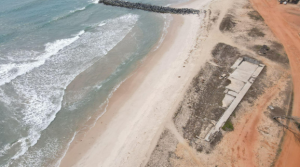
The sea wall provides a buffer for Prinzenstein Fortress in Keta, protecting what remains of the 240-year-old former slave post from coastal erosion. Image by: Richard A. Abbey
Fort Kongenstein in Ada has been completely submerged by the Atlantic Ocean. The stump of a local elementary school near the destructive Atlantic Ocean.
Image by: Richard A. Abbey
The post Ghana’s historic sites face climate change damage appeared first on Citinewsroom – Comprehensive News in Ghana.
Read the Full Story
Advertise Here contact advertisement[@]ghheadlines.com