
Six insightful data sets confirm the rapid rise of interest in Bitcoin inscriptions, showing an undeniable impact.
Writing bits of data to the Bitcoin blockchain via Ordinals has attracted the attention of cryptocurrency enthusiasts deep within and beyond Bitcoin since its inception in 2023.
Whether or not Bitcoin “should” be used for activities like NFT is a hotly-contested issue and the data coming from the effects of the mini Bitcoin collective craze is interesting. Inscriptions may be a short-lived fad, but some early data sets from the first week of inscription activity show tremendous interest in this new use case for the Bitcoin network. Dive in, this article provides an overview of six data sets from inscription mania.
Bitcoin Inscription Data Summary
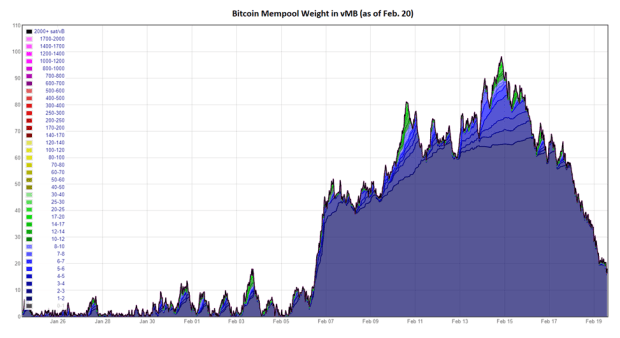
The number and weight of pending transactions in Bitcoin mempools around the world is a clear signal of how popular inscription transactions are for Bitcoin users amid the mini-craze over Bitcoin NFTs. Throughout the current bear market cycle, the level of pending transactions in Bitcoin mempools has remained low, especially when compared to the highs of the bull market of 2017 and 2021. In fact, the Twitter bot called Mempool sign tweets every time the mempool is empty, and tweets are sent consistently for months during 2022.
The mempool pending transaction visual below shows the total weight of unconfirmed transactions in most of February 2023. The increase in pending transactions is directly related to the inscription craze, which subsided slightly at the end of February.
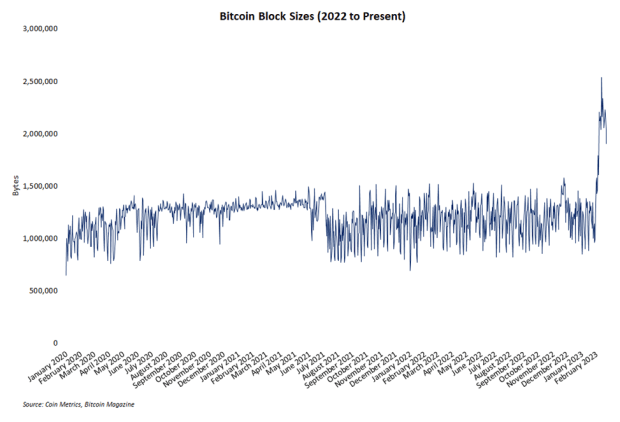
Inscription transactions are extremely popular, and the resulting block sizes from the inscription craze prove it. For years, Bitcoin’s block size has hovered just under 1.5 megabytes (MB) as shown in the bar chart below. But the vertical increase in the block size on the right side of the graph is due to all the Bitcoin inscriptions.
With these Bitcoin NFTs becoming popular, blocks began to be produced between 2 MB and 2.5 MB on average. Some blocks flirted with the 4 MB limit, including the “giant” Taproot Wizard block mined by Luxor in collaboration with Udi Wertheimer and others.
Moving to “off-chain” data, interest in Bitcoin inscriptions is also evident from Google Search queries. The following line chart is taken from the Google Trends page for search interest in “Bitcoin Ordinals,” and the near-vertical increase in interest over time cannot be missed. It should be noted that this data set of search trends is scored on a relative basis for searches of interest in the past week and year. But what is really important is that Google Trends has indexed this phrase. Not every term or phrase is indexed by Google Trends, only those with minimal search volume over time. The trend data for “Bitcoin Ordinals” makes the database very interesting.
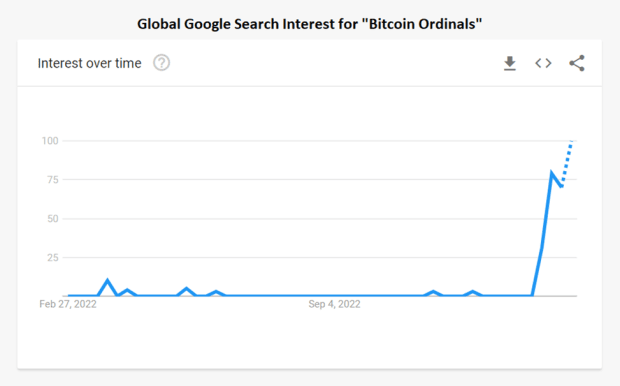
Critics of NFTs – and especially inscriptions on Bitcoin – will sometimes belittle all types of network use as a form of “privilege” by elites in developed countries goofing around with serious monetary networks. But global trends for Ordinal searches do not show the US as a top five country. Singapore, the Czech Republic, Portugal and Singapore top the list, according to Google data.
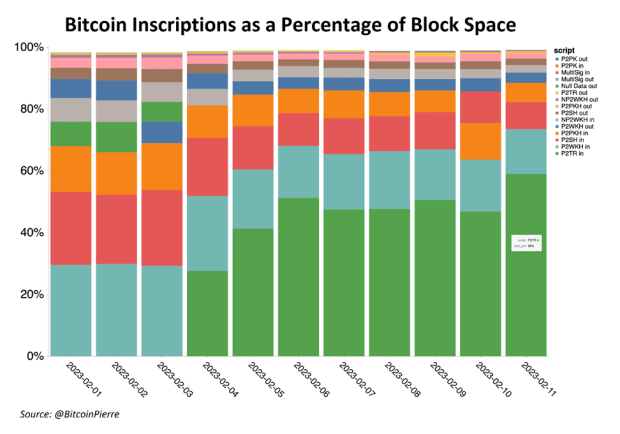
Sorting according to the form of transactions included in the block also reflects the intensity of the inscription madness that begins in 2023 for Bitcoin. according to data shared to Twitter from a Bitcoin node managed by Pierre Rochard, director of research at Riot Blockchain, inscription transactions account for nearly 60% of the block space near the height of the Bitcoin community’s first foray into Ordinals. As the data visualization below illustrates, that number continues to grow from 20% to 60% within a week.
Community data from a group of inscription enthusiasts also presents some additional context for this social and technical movement in Bitcoin. The bar chart below shows the data collected by OrdinalHub with a list of original inscription Discord groups and the number of members since the beginning of February.
By a large margin, Satoshibles and Taproot Wizards were the largest communities at the time. But many Discord groups are almost immediately created to signal the enthusiasm that Bitcoin artists have for using this new network.
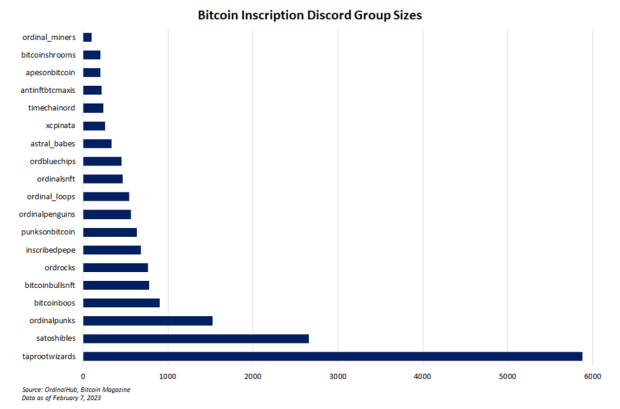
Now, many Discords are definitely bigger than the data in the chart above. But now, some of that data has definitely been corrupted by bots and various other spoofs (intentional or not) of community data, which makes a snapshot of data taken close to the origin of the community unique.
One last piece of data that deserves to be included in the analysis of Bitcoin inscriptions is about money – how much the miners make from the “inscribeoooors” who emit bits of data into the Bitcoin network. Miners are paid handsomely for building blocks with inscription transactions.
In the line-by-line combination chart shown below, the daily amount spent on inscription transaction fees and the total amount paid to miners from inscription transactions are depicted. In a few short weeks, more than $1 million has been paid to miners from the inscriber. And this data only takes on-chain payments – out-of-band payments are not included here, which would make the numbers bigger.
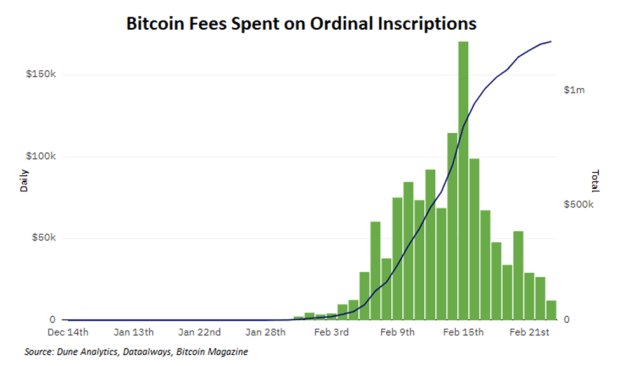
Although many preliminary data sets indicate that the intensity of early inscription activity has decreased relative to its peak in late February, the duration of this trend is unknown. It could be a fad that dies before the current bear market ends, and critics of the inscription can then dance on the grave of Bitcoin NFTs. Or it can be the desired equipment for the block board and regular fee income for the miners.
The future is uncertain, but the possible effect of the inscription cannot be ignored.
This is a guest post by Zack Voell. Opinions expressed are entirely their own and do not necessarily reflect those of BTC Inc or Bitcoin Magazine.