
This article is an onsite version of the Europe Express newsletter. Sign up here to have our newsletter sent straight to your inbox every weekday and Saturday morning
Welcome. US President Joe Biden, speaking in Warsaw on the eve of the first anniversary of Russia’s full invasion of Ukraine, said that Vladimir Putin “can end the war with words”. But the Russian leader will not take such a step unless he can claim victory on terms unacceptable to Ukraine and its western backers – which was clear from Putin’s public speech in Moscow this week. So what will happen next? I’m at tony.barber@ft.com.
Predicting the outcome of such a long war is inherently risky. Who in November 1917 predicted that, 12 months later, France, Britain, the US and their allies would achieve complete victory in the first world war against Germany and the other Central Powers?
After spending this week sifting through the various comments on the Ukraine war, I have the impression that the consensus prediction is that neither side will win, there is no peace settlement in sight and even a ceasefire – temporary or otherwise. – unlikely anytime soon.
A war of attrition
A remarkable analysis that explains this argument comes from Thomas Graham, a distinguished fellow at the Council on Foreign Relations and a former Moscow-based US diplomat. Writing for the Harvard Kennedy School’s Russia Matters website, Graham explained that the domestic politics of Russia, Ukraine and the US all point to the continuation of a “war of attrition”.

Here are Graham’s thoughts on Putin:
He has shown no interest in negotiating anything other than the capitulation of Ukraine. . . His hyperbolic rhetoric, likening the conflict to a great patriotic war of survival against Hitler and Napoleon, limited the room for manoeuvre.
On Ukrainian president Volodymyr Zelenskyy: “[He] has committed himself to total victory. . .[He]cannot trade land for peace and hope for political life.
On Biden, the war and the 2024 US presidential election: “Once framed as a historic contest between democracy and autocracy . . . Biden cannot see Ukraine defeated and hope to be re-elected.
The US President himself stated in Warsaw:
President Putin chose this war. Every day the war continues to be his choice. He can end a war with words. It’s simple. If Russia stops attacking Ukraine, it will end the war. If Ukraine stops defending itself against Russia, this will be the end of Ukraine.
That last point was reinforced in an article by Carl Bildt, the former prime minister of Sweden, for Project Syndicate that appeared in the Korea Times. What would have happened, Bildt asked, if Russia had won the war so quickly a year ago?
[Zelenskyy] most likely would have been killed by Russian special forces or imprisoned after a quick trial. At best, he will lead a government in exile from Warsaw or elsewhere. . . Ukraine as a political entity will no longer exist, returning to the status it held under Russian imperialism in the 19th century.
Thus, Ukraine continues to struggle, despite the high number of casualties, the mass displacement of civilians and the devastating impact of the war on the economy, as mentioned in this IMF report in December.
The Western military and financial support of Ukraine’s war effort remains, although – as the FT reports – the finance ministry in Kyiv appears to have received, until December, only €31bn of the €64bn promised by western countries since the invasion.
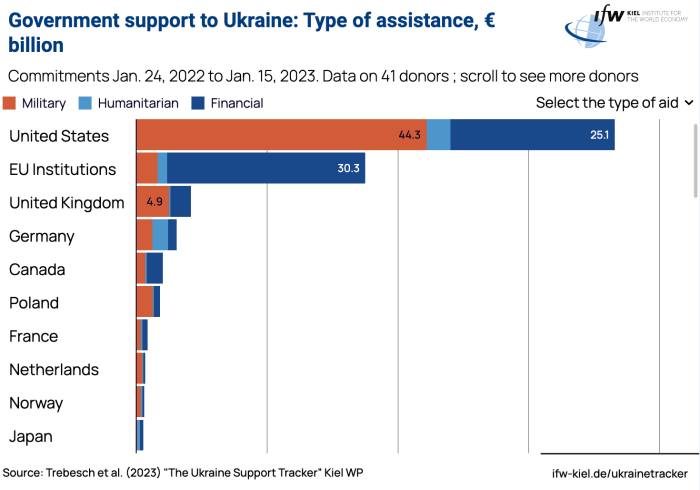
As the Kiel Institute chart above shows, the US provides the largest aid to the west, but for how long?
Felicia Schwartz, a Washington-based US foreign and defense correspondent, writes that strong political and public support for providing arms and money to Ukraine is weakening, and may come under pressure as the 2024 elections approach.
The purpose of war
Any significant reduction in US support would certainly undermine Ukraine’s hopes of achieving all of its war aims. This has hardened, as the conflict has intensified, towards the full restoration of government control in every area held by Russia since 2014, including Crimea and the southeastern Donbas region.
Few western leaders dared to suggest in public that the war’s aims were too ambitious, but some thought so privately. Russian atrocities in the occupied zone and the deportation of Ukrainian civilians, including thousands of children, have made it very difficult for western leaders to float the idea of leaving the region under Moscow’s control – even as part of a ceasefire, let alone long-term. settlement.
However, it is no less true that Putin has carefully learned to avoid spelling out Russia’s war in detail. Will he be comfortable with Crimea and the four other regions of Ukraine announced in September to be annexed to Russia, even though they are not under Moscow’s full military control?
Putin and the fate of Russian history
In my opinion, it would be unwise to assume. The destruction of the independent Ukrainian state after 1991, and the absorption of Ukrainian identity into a Russian-led eastern Slavic union, seems to me to be the basis for Putin’s increasingly mystical conception of Russia’s fate.
Few have described Putin’s obsession more succinctly than historian Thomas Otte, writing for the H-Diplo website almost a year ago:
Putin’s view. . . reflects the embrace of the fundamental anti-western, anti-European concept of Russian mir [the Russian world]a partly historical, partly ideological construction that draws on the idea of the Holy Rus’ of the 10th century – itself a “discovery” of historians of the 19th century.
It embodies the late tsarist idea of an ethnocultural pan-Slav bond between the eastern Slavs, and is supported by the memory of the victory against fascism in the Great Patriotic War.
Otte also emphasized the importance of Putin’s claim-filled grievance that the west betrayed Russia after the cold war by accepting the newly free, former communist countries of central and eastern Europe to NATO. Mary Elise Sarotte, a leading authority on the diplomacy of the era, demolished the argument in the FT last weekend.
However, as Otte points out, Putin’s accusations of western bad faith have become synonymous with the nationalist myth of post-1918 German right-wing nationalists, according to whom Jews, socialists and other “traitors” have caused the country. lost the first world war.
In short, Putin’s thirst for conquest, revenge and a place of honor in Russian history remains unquenched. Former Russian diplomat Boris Bondarev, who resigned last year in protest at the attack on Ukraine, offered insight into Putin and the officials who served him:
They will always be a source of war, aggression, destabilization. . . This war is a personal war because no one wants this war. And now he doesn’t want to. They only obey because they are not responsible for thinking and deciding.
What do you think? Will the war in Ukraine end by the end of this year? Vote here.
How Russia’s war is disrupting global energy routes – analysis by Benjamin Storrow and Sara Schonhardt for E&E News
This week’s Tony picks
-
Ayatollah Ali Khamenei has embraced a more active role in public life as he seeks to rein in the Iranian regime after the strongest demonstrations since the Islamic revolution, FT Najmeh Bozorgmehr reports from Tehran.
-
Poland’s ruling Law and Justice Party has been in retreat for the past three and a half years, but still has a chance to retain power after parliamentary elections due later this year, said Aleks Szczerbiak, a professor of politics at the UK. University of Sussex
Recommended newsletters for you
Britain after Brexit – Keep up to date with the latest developments as the UK economy adjusts to life outside the EU. Log in here
Welcome work – Discover the big ideas shaping today’s workplace with a weekly newsletter from work & careers editor Isabel Berwick. Log in here
Do you like Europe Express? Log in here to be delivered straight to your inbox every weekday at 7am CET and on Saturdays at noon CET. Tell us what you think, we’d love to hear from you: europe.express@ft.com. Stay up to date with the latest European stories @FT Europe