
Western leaders used the gathering of global elites in Munich to make the case that Russia’s invasion of Ukraine poses a threat not just to Europe but to the entire world. There is no evidence that the order was carried out.
Speaking at the Munich Security Conference, a group of senior US and European officials sought to reassure the rest of the world of the threat posed by President Vladimir Putin’s invasion – and pointed out that the blame for higher global food and energy prices lies with Moscow. .
US vice president Kamala Harris said that “no country is safe” in a world where “one country can violate the sovereignty and territorial integrity of another”.
French President Emmanuel Macron said Russia’s “neocolonial, imperialist” invasion was not just a “European war”. German Chancellor Olaf Scholz said it would be everyone’s problem if “the strongest law prevails in international relations”.
But attempts to describe the war in universal terms met some familiar retorts.
Brazilian Foreign Minister Mauro Vieira said the conflict was a “very sad situation” and stressed his government’s “sadness” of the invasion.
However, in a message that jarred with the attitude of the western participants asking to decide on a long war in Ukraine, Vieira added: “It’s been a year now. We have to try to build a possible solution. We can’t keep talking about war.”

Left to right: French President Emmanuel Macron, Polish President Andrzej Duda and German Chancellor Olaf Scholz address the media at a bilateral meeting © Johannes Simon/Pool/EPA-EFE/Shutterstock
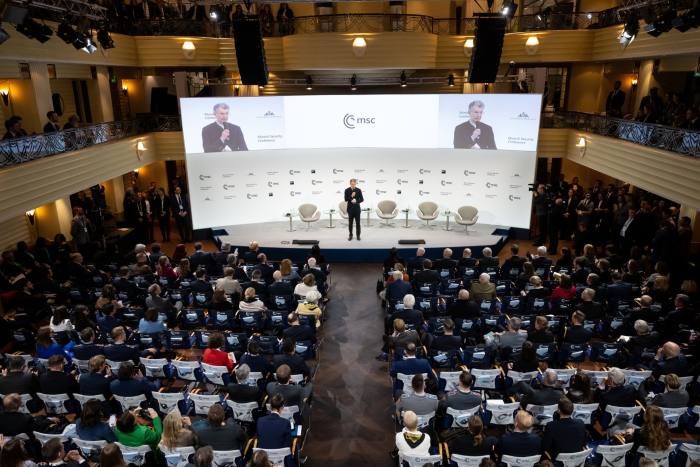
The organizers of the annual meeting in the Bavarian city are proud that this year’s event has a number of participants from countries called the global south, although it remains dominated by officials from Europe and the US.
There is palpable frustration among some leaders from African and South American countries that the war in Ukraine, which on Friday will enter its second year, has consumed the west’s time, money and attention at the expense of other issues.
Francia Márquez, Colombia’s vice president, said his country wanted European help to deal with the fallout from climate change and protect the Amazon rainforest. “We don’t want to keep discussing who will win or lose the war,” he said. “We are all losers and, in the end, it is humanity that loses everything.”
Namibian Prime Minister Saara Kuugongelwa-Amadhila was asked why her country – along with China, India and 32 other countries – rejected a UN resolution in October that saw 143 countries declare Russia’s annexation of parts of Ukraine illegal.
He said Namibia was focused on “solving the problem, not on changing the fault”. He added: “The bottom line is that the money used to buy weapons would be better used to promote development in Ukraine, in Africa, in Asia, in the European Union itself where many people are suffering.”
Western officials said bilateral meetings with global south leaders on the sidelines of the conference showed greater concern over issues such as inflation, debt, higher energy prices and food security than the war in Ukraine. There is also anger, he said, because of the West’s disappointing record on sharing a coronavirus vaccine and compensating for the damage caused by climate change.
Christoph Heusgen, chairman of the Munich Security Conference, gave a closing statement on Sunday © Sven Hoppe/dpa
EU foreign policy chief Josep Borrell, meanwhile, acknowledged the west’s own troubled past, citing European colonialism in Africa and western support for dictatorships in Latin America in a speech on Sunday. “People have memories and people have feelings,” he said. “We need to participate more, show that we defend universal values.”
Comfort Ero, president of the conflict prevention organization Crisis Group, welcomed what he said was an “important effort” from the west to respond to criticism that it is putting other countries through a “loyalty test” in Ukraine and not listening to their concerns. . “Talking is important. Listening is important,” he said. “The key is how it translates into real policy engagement and practical results.”
Ero added that it is important not to unite these countries, pointing out that, while South Africa rejected last year’s UN vote on the annexation of Russia, Ghana and Nigeria were among the African countries that voted.
China’s stance on the conflict loomed large at the Munich meeting along with tensions between Beijing and Washington. Amrita Narlikar, president and professor at the Hamburg-based German Institute for Global and Regional Studies, said that European and American officials should do better to counter what he called “very smart” China itself as part of the global south, where it promotes itself. itself as a partner to help countries maintain their sovereignty and promote development.
Narlikar said the peace plan for the Ukraine conflict that Beijing has promised to publish in the coming days – drawing skepticism from European and US officials – may target not just the west. “Equally important, the global south can be expected to be the audience,” he said.
“If China will present its vision as one of a peace dialogue between Russia and Ukraine, and emphasize the global economic costs of the long-standing war, this will gain a lot of support in the global south.
“The West needs to act together and build a more inclusive and winning narrative,” he added.