
Inflation is headed higher to start 2023, as rising prices for shelter, gas and fuel hurt consumers, the Labor Department reported Tuesday.
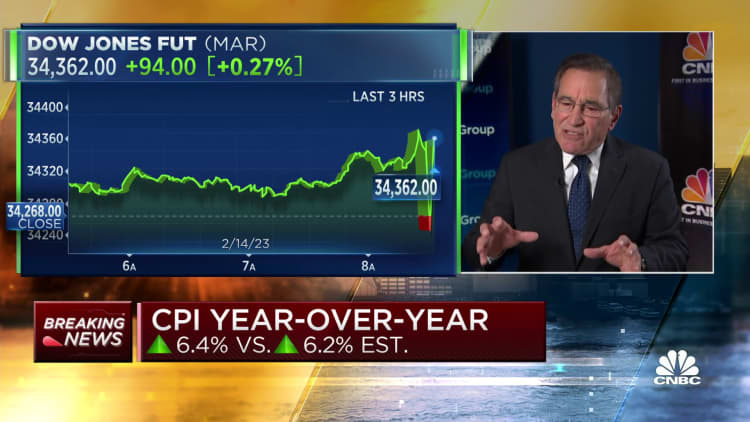
The consumer price index, which measures the overall purchase of general goods and services, rose 0.5% in January, which translates into an annual gain of 6.4%. Economists surveyed by Dow Jones had been looking for increases of 0.4% and 6.2%.
Excluding volatile food and energy, core CPI rose 0.4% month-on-month and 5.6% from a year ago, against estimates of 0.3% and 5.5% respectively.
The market was volatile after the release, with Dow Jones futures around flat.
Shelter costs rose by about half the monthly increase, the Bureau of Labor Statistics said in the report. The component accounts for more than one-third of the index and is up 0.7% in the month and up 7.9% from a year ago. CPI has risen 0.1% in December.
Energy was also a significant contributor, rising by 2% and 8.7%, respectively, while food costs increased by 0.5% and 10.1%, respectively.
Rising prices mean a loss in real wages for workers. Average hourly earnings fell 0.2% for the month and were down 1.8% from a year ago, according to a separate BLS report.
While price increases have abated in recent months, January data show that inflation is still a force in the US economy in danger of slipping into recession.
This is despite the Federal Reserve’s efforts to address the problem. The central bank has raised benchmark interest rates eight times since March 2022 as inflation rose to its highest level in 41 years last summer.
In recent days, Fed Chairman Jerome Powell has talked about “disinflationary” forces at play, but the January numbers show the central bank probably still has work to do.
There is some good news in the report. Medical care services fell 0.7%, airline fares fell 2.1% and used vehicle prices fell 1.9%, according to seasonally adjusted prices.
The increase in housing prices remains the floor of inflation, although the numbers are expected to decelerate later in the year. That’s why some Fed officials, including Powell, have said they are looking at core services inflation minus shelter prices to determine policy.
Markets expect the Fed to raise overnight lending rates by another half a percentage point from its current target range of 4.5%-4.75%. This will give policymakers time to monitor the wider economic impact of monetary policy tightening before deciding how to proceed. If inflation doesn’t fall further, it may add to rate hikes.
There is widespread belief that the economy could enter at least a shallow recession by the end of this year or early 2023. However, the latest tracking data from the Atlanta Fed put GDP growth expected at 2.2% for the first quarter, after a fairly strong finish to 2022. .
The January CPI report will take some time to analyze, as the BLS changes its methodology on how it reports the index. Some components, such as shelter, are given a higher weight, while others, such as food and energy now have a slightly lower impact.
The Fed also changed the way it calculates an important component called owner-equivalent rent, a measure of how much property owners can earn if they rent. The BLS is currently focusing more on rental prices themselves than apartments.
This is new news. Please check back here for updates.