
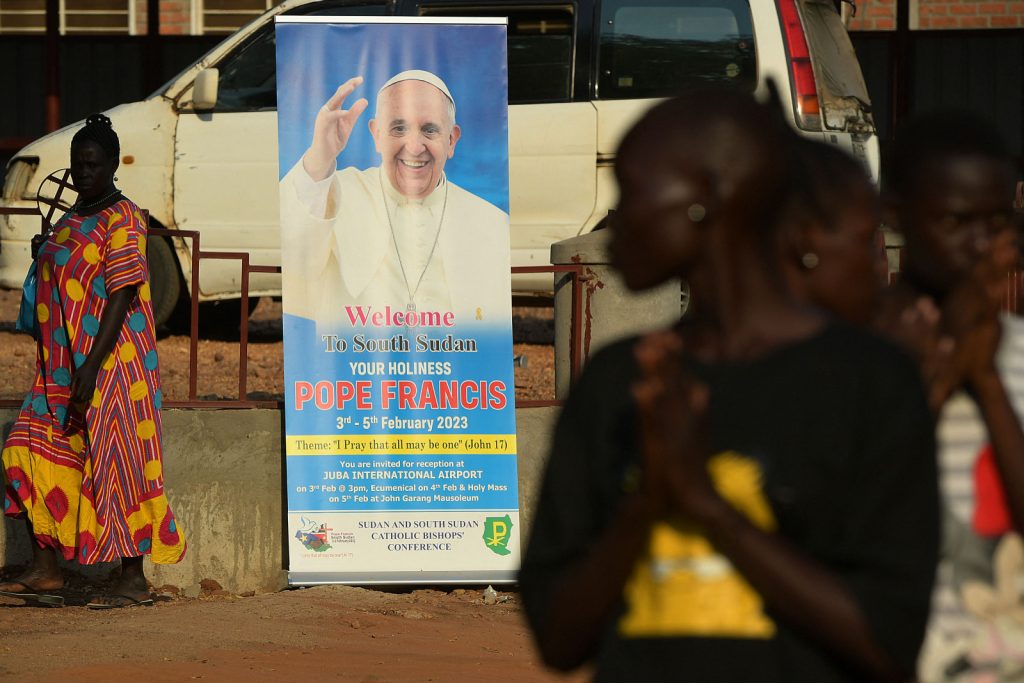
Pope Francis, head of the Catholic Church, visited the Democratic Republic of Congo and South Sudan last week. The visit increased the focus on the growing role of African Catholics in the church.
Africa is home to almost 20% of the world’s Catholics – 236 million of the world’s 1.36 billion Catholics. And this church is growing faster than anywhere else in the world. Recent statistics show that it grew by 2.1% between 2019 and 2020, compared to only 0.3% in Europe.
The majority of Catholics in Africa are young people – the average age of the continent is about 19. This contrasts with the trend in many parts of the world, where young people are leaving the church because they think too much and are conservative.
The Pope wants, in particular, to encourage African youth to play a greater role in shaping the future of the church and society in their respective countries – and perhaps encourage them to support their own reform agenda, which is unpopular on the continent. .
Although large crowds have enthusiastically welcomed Francis in Kinshasa and Juba, many Catholics will have views that conflict with his forward-looking vision. Many Catholic dioceses and institutions in Africa adopt a more conservative style of Catholicism in doctrine and ritual.
African bishops will agree with Francis on some of the issues he often addresses – poverty, care for the environment, social injustice, corruption and war.
However, many of these prelates will also back down and stand firm against Francis’ progressive stance on divorce and remarriage, for example.
It is no secret that many African Catholic leaders do not embrace the style, vision and reform agenda of Pope Francis. This is especially clear when it comes to issues like homosexuality, clerical privileges, church structure and the role of women in the church.
Some leaders, such as Archbishop Alek Banda of Lusaka, Zambia, have recently supported the criminalization of their country’s LGBTIQ community. Many young priests ordained from African seminaries will hold to a more conservative theology. They will be suspicious of the “liberation theology” closely identified with the Francis pontificate.
The decrease in the number of young people entering seminaries in the northern hemisphere means that many Catholic priests in the world will be of African descent. This fact only changed the face of global Catholicism from the church in the north, with European missionaries, to the church in the south made mainly of missionaries from areas like Africa.

This will not only shape global Catholicism in the years to come, but will also have a great impact on African Catholics in shaping the future of the church.
Francis has often spoken about the African church being given more voice in the church and in the world. He has visited the continent at an important moment in the history of global Catholicism, when he seeks to listen more closely to those on the margins.
In 2021, he started an ambitious global consultation in the Catholic Church called “Synod on Synodality”.
Francis asked the whole church to enter into dialogue and talk about whatever needs to be addressed. He has reiterated that anything can be said in the process, which will be completed next year.
He hopes to hold a dialogue with African Catholics in particular, although some issues that are already on the global table – such as women in ministry, compulsory celibacy for clergy and homosexuality – have been neglected by African Catholics.
Unfortunately, in some places on the continent, nothing is being done by local leaders to participate in this process. They do not agree with the pope’s approach, characterized by dialogue.
Francis also visited churches divided by culture, language and ethnicity. A tragic example of this is the ongoing conflict in Cameroon between the predominantly French-speaking government and rebels in the English-speaking region, which has claimed thousands of lives.
Leaders in the Catholic church are divided and cannot speak with one voice because they are also rooted in the country’s colonial history.
Francis hopes that young people can play an increasingly active role in solving the many conflicts and poverty that spread across the continent. In the DRC last week, the pope told Catholics to be a “conscience for peace” and to “break the cycle of violence”.
The church often plays an important role in solving social problems. For example, Catholic bishops in the DRC and Nigeria organized successful protests against violence. In addition, the Rome-based Catholic organization Sant’Egidio made peace in Mozambique, ending the civil war in 1992.
In many countries, the church also fills countries where corrupt and corrupt governments fail to meet the needs of their people.
For example, the highest number of Catholic health facilities in the continent (2 185) in the DRC. It is followed by Kenya (1 092) and Nigeria (524).
Francis urged young people in the DRC to reject greed and corruption, criticizing politicians who have embezzled millions and private benefits from the natural resources of some countries. He encourages the youth to choose a future that is different from the past.
In Kinshasa, this call was immediately received by the masses, who began to demand an end to the government of President Felix Tshisekedi, a president whose election victory was not recognized by the church.
This is the Pope’s fifth visit to Africa in 10 years, underscoring how important it is for him to see the continent.
Given the exponential growth of African Catholicism, it is not much of a stretch to wonder, what is the next Pope of Africa?
This article first appeared on Continenta pan-African weekly newspaper produced in partnership with Mail & Guardians. It is designed to be read and shared on WhatsApp. Download your free copy here.