
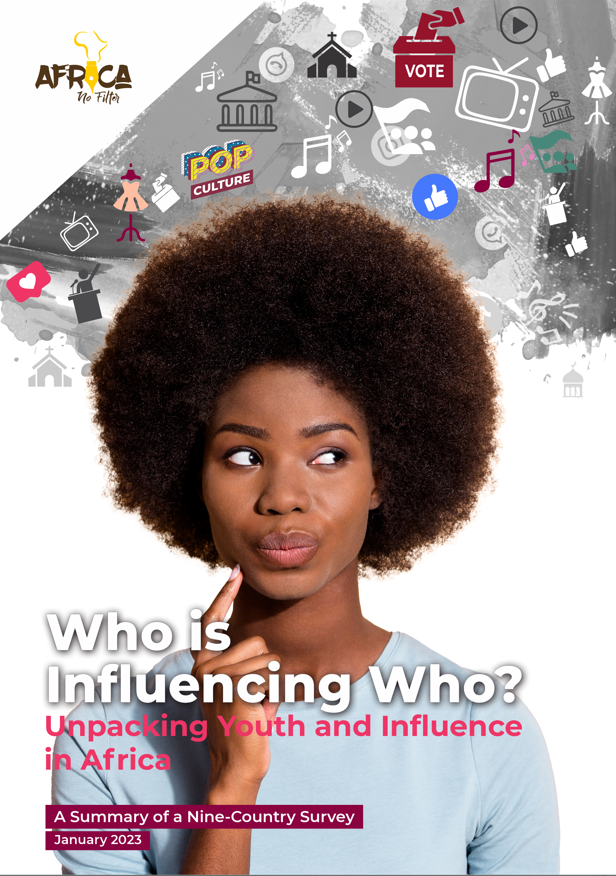
JOHANNESBURG, South Africa, 06 February 2023 -/African Media Agency(AMA)/- Pop culture is the biggest influence on African youth, according to Who is Influencing Who? Unpacking the report Youth and Influence in Africa.
The latest report by Africa No Filter investigates Africa’s impact on the world, its impact on African youth, and how dominant narratives about Africa shape youth perceptions of the continent. The study interviewed 4500 people aged between 18 and 35 in Nigeria, Ghana, Ivory Coast, Morocco, Egypt, Uganda, Kenya, Zimbabwe and South Africa.
57% of respondents said pop culture had the biggest influence, followed by the US and Europe (45%), and politicians (31%). Regionally, pop culture has the strongest influence in Kenya (87%) and Zimbabwe, while West African respondents (65%) consider the US and Europe to be more influential.
Interestingly, although politicians are perceived to be influential, only 11% of those interviewed said they were influenced by politicians.
As stereotypical narratives about Africa abound, the report asked young Africans what they thought were the dominant negative stories about the continent in films. 54% said that the general negative narrative is about crime and corruption, followed by narratives set in underdeveloped cities (41%) and portraying uneducated and unexposed Africans (33%).
Regarding the impact on the perception of the world, 75% of respondents said that the story created a negative perception of the continent. However, it does not stop them from loving their country and continent (60%) or believing that African countries – especially South Africa, Nigeria, and Egypt – have global influence (73%).
Moky Makura, Executive Director at Africa No Filter, said: “This is a must read for any organization that works and in Africa because it uncovers what affects the continent’s largest demographic. Unfortunately, African youth are not exempt from the influence of negative stereotypes, but the good news is that they do not define the perception – and it has to do with social media , and the agency provided.”
Here are the main findings of the report:
1. Social media is very powerful: 71% of respondents believe that they can challenge negative stereotypes about the continent on social media. While the report does not identify the origins of this belief, previous research has produced several examples of how young Africans have – and continue to – modify negative stereotypes on a global level.
2. Love for countries and continents: Although 45% of respondents believe that their perception is shaped by negative narratives about the continent, 60% still love their country and the African continent. Only 18% of respondents indicated that they would prefer to live in the United States or Europe and only 20% believe that there are fewer opportunities on the African continent than elsewhere.
3. The power of pop culture: The main influences on respondents were pop culture (57%), social media (27%), family and friends (44%), religion (74%) and community cultural practices (54%). While 45% of respondents believe that other young Africans are strongly influenced by the United States and Europe, they state that, for them, family and friends have the greatest influence.
4. Politicians have influence, but they do not influence the youth: Although 58% of respondents said politicians were the most influential people in their country, only 11% said they were influenced by politicians. The only time respondents said they were influenced by politicians was when making electoral decisions (51%).
5. Films challenge stereotypes: For 54% of respondents, the most common narrative about Africa in films is about crime and corruption. 41% said they told stories about underdeveloped cities. 75% of respondents believe that these stories create a negative perception of the continent, with Kenya (83%), Ghana and Zimbabwe (82%) most convinced of the negative impact.
Distributed by African Media Agency on behalf of No Filter Africa.
Question:Lerato@africanofilter.org
Research Method:
The report interviewed 4500 people aged 18 and 35 in Egypt, Morocco, Ghana, Ivory Coast, Nigeria, Kenya, Uganda, South Africa and Zimbabwe – to represent the four geographical regions of Africa (East, West, South and North Africa). Random sampling was used to reach 500 respondents in each country. The questions were designed by GeoPoll and Africa No Filter and were conducted in English, French and Arabic. The poll was conducted in April 2021. Our intention is to extend this study to other countries at a later stage.
About Africa No Filter:
Africa No Filter is a donor collaboration working to change stereotypical and harmful narratives in and about Africa. Through research, grant making, community building and advocacy, our goal is to build a field of narrative change makers by supporting storytellers, investing in media platforms, and driving disruptive campaigns. The donor collaboration is funded by the Ford Foundation, Bloomberg, Andrew W. Mellon Foundation, Luminate, Open Society Foundations, Comic Relief, Hilton Foundation, British Council and Hewlett Foundation.
You can follow Filter No Africa at:
Tik Tok
The post Pop culture is the biggest influence on African youth, according to a new report that appeared first on the African Media Agency.