
This is an editorial opinion by Q Ghaemi, stock and bitcoin analyst and author of the Qweekly Update newsletter.
Earlier this month, reports emerged that the Central Bank of Iran was working with the Russian Association of Crypto and Blockchain Industries to create a stablecoin that would be backed by gold to settle trade. This isn’t the first foray into the crypto world for either country, and it won’t be the last. But this effort will come to nothing, which ultimately brings the two countries closer to Bitcoin.
Iran’s Foray into Cryptocurrencies favors Bitcoin
In August 2022, a headline came and most people didn’t hear about it, and those who didn’t thought about it: “Iran Approves Use of Cryptocurrency For Imports To Violate Sanctions.” Ignoring the fact that the source of this headline is a Saudi-funded media outlet with the aim of discrediting and delegitimizing Iran, it is important to note that Iran succeeded in completing a trade in August worth approximately $10 million, which is possible. considered to have been done in bitcoin.
Based on the daily volume, there are about 20 cryptocurrencies that can be used to complete this transaction, but if we take these cryptocurrencies by daily volume and agree that no one with a daily volume of less than $ 1 billion can be used (any ). more than 1% of daily volume will move the price very much: 1% of $1 billion is $10 million) we still have seven cryptocurrencies: Ripple (XRP), Solana (SOL), USDC, Ethereum (ETH), Binance (BNB) , Tether (USDT) and Bitcoin (BTC).
We can quickly eliminate USDC, Solana and Ripple because they are all managed by US companies and, due to the sanctions law (see: Tornado Cash), they will be forced to prevent Iran from using their platforms (it is also safe to assume that the Iranian Government chooses to avoid US companies for simplicity ). Tether can also be dumped because it is tied to the US dollar. I would also throw in Ethereum because Iranians are too cheap to pay for that gas. It gives you two options: BNB and Bitcoin. Personal bias aside, no one completes an international trade with BNB without Binance CEO Changpeng Zhao (CZ) taking a few victory laps. Bitcoin wins.
Iran has also previously banned Bitcoin mining operations due to stress on Tehran’s power grid. It has now produced all the mining equipment and, as mentioned above, made a claim that $10 million in international trade was done using cryptocurrency. Suffice it to say, Iran has begun to see the potential of Bitcoin.
Russia’s Foray into Cryptocurrencies Shows the Need for Sanction-Free Exchanges
Russia has also begun dipping its toes into the broader cryptocurrency space. After the US government responded to the invasion of Ukraine with sanctions, Russia was forced to explore alternatives to settle international trade. President Vladimir Putin’s response was to wipe out more than $500 billion in reserves and order that every buyer of Russian natural gas pay in Russian rubles. The ruble responded positively to this news (see the chart below with the red arrow showing when the US sanctions started and the green arrow showing when the ruble became the only payment for Russian natural gas).
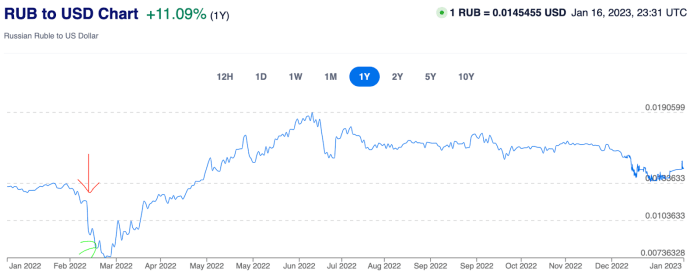
Source
Russia then slowly began to reverse its 2020 position on cryptocurrencies. Late last year, Russia announced it would allow international settlements in cryptocurrencies without restrictions, a major reversal from its previous stance. The move proves that Russia sees the potential of cryptocurrencies as a medium of exchange.
Sanctions Create Stronger Bonds
Both countries have accepted US/Western sanctions but have found ways to navigate around them to stay in power. The lesson learned from both countries is not to trust anyone, especially when it comes to finances. Putin profusely announced that by freezing Russia’s dollar holdings, it is “practically defaulted,” signaling that even the mighty dollar may not be as mighty as the US wants you to believe.
Iran is also no stranger to empty promises from the West: after negotiating and agreeing to a nuclear deal in 2015, President Donald Trump came and tore up the old agreement. Although this is a common practice in some (shady) business ventures, it is an insult in Persian culture. Every indication that a new nuclear deal will be signed by Iran is laughed at: why does Iran think the next deal will be done after this president leaves office? Needless to say, the Iranian government does not trust foreign governments very much.
“The enemy of my enemy is my friend” plus “keep your friends close but your enemies closer” is the same as Iran/Russia relations.
In 2023, it almost makes sense to Westerners that Russia and Iran will work together. Both countries are considered evil by many Western countries, and strict sanctions prevent them from selling their resources to the rest of the world. Both have oil and gas stocks that the world desperately needs. However, their history is far from harmonious.
Until the 1920s, Britain and Russia fought over Iran’s resources. The Qajar dynasty would bend the knee and give whatever foreign power asked in exchange for wealth and riches for their families. This all changed after the 1921 coup ended the Qajar dynasty and brought Reza Shah to power.
Reza Shah refused to make concessions to foreign powers and focused on developing Iran. The Soviet Union became a year later, which caused the USSR to also focus on domestic growth. As Iran began to grow in importance in the West (especially in Britain and the US), Reza Shah and his son (the last Shah of Iran, Mohammad Reza Shah), would use the fear of communism to their advantage. If Iran is not going to get what it wants from its Western trading partners, it will make a small deal with the USSR to remind them who is in charge.
Although there is a history of controversy between the two countries, they seem to have found a common ground: the perception of the enemy of the West.
Why New Stablecoins Will Fail
I made a tall claim that the stablecoin experiment between Iran and Russia would fail and cause them to adopt Bitcoin. How will it fail? There is no trust: there is not and never will be.
Trust can be broken when networks are formed. While many Russian and Iranian leaders may believe that their country’s top engineers can create products that can withstand an enemy attack, what should stop other countries from giving them backdoor access? What’s stopping people from inventing ways to spend tokens twice? Now, this is all speculation: I just listed a few potential flaws in this system – how many more can you think of?
The biggest question is about the gold reserves that support stablecoins: Where will the gold be stored and who will verify that the listed amount of gold still exists? Because of the lack of trust, no country can blindly hope that another country holds the amount of gold it claims (see “Bitcoin Standard” for more on this topic), and sanctions prevent reputable third parties from acquiring it. involved (although China may fit into the puzzle in some ways here).
When this enormous and important obstacle is overcome, another question will continue to arise: Why? Why do we need to do any of this when there is a cryptocurrency out there with enough liquidity to meet our needs and that does not require trust on either side?
Both Iran and Russia have banned citizens from using Bitcoin, but have also reversed some of their positions over time. It is safe to say that both governments are still in the process of understanding the power and scope of cryptocurrencies have to offer. It should also be noted that, if this joint venture is successful, it will not be the first gold-backed cryptocurrency.
Conclusion
Both countries are still in the stage of gathering information and, if by some miracle, researchers stumble upon this article, let me say it clearly and simply: History has proven that when given the opportunity to control money, the people in charge will manipulate the money for their own benefit.
There is a reason the Roman Empire fell and we don’t use the guilder or the pound as a global currency. Instead of bringing this temptation into the equation, adopting an unreliable form of money that cannot be manipulated or developed is the only solution. Bitcoin is the impossible money you are looking for. Whether you get there before your opponent is up to you.
This is a guest post by Q Ghaemi. Opinions expressed are entirely their own and do not necessarily reflect those of BTC Inc or Bitcoin Magazine.