
Lawmakers from the US states of Mississippi and Missouri have introduced bills that seek to legally protect the rights of citizens to open Bitcoin nodes and to mine BTC.
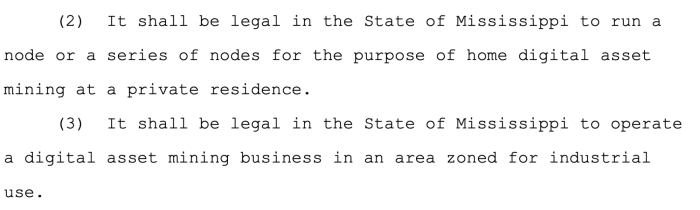
Excerpt from Mississippi bill
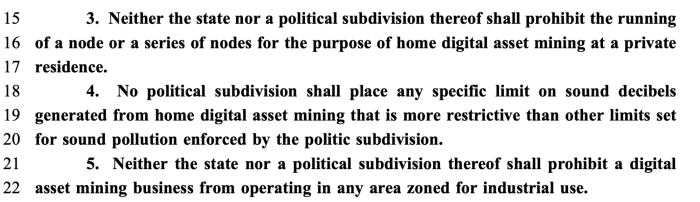
Excerpt from Missouri Bill
Bills have been submitted to the Houses and Senates of each state, with Senator Josh Harkins (R) and Representative Jody Steverson (R) leading the movement in Mississippi. Representative Phil Christofanelli (R) of Missouri sent his respective bill to the House of Representatives. Both countries’ bills use language from the Satoshi Action Fund. Among the explicit rights for nodes and mining, the bill also has language that prohibits:
- The country’s political subdivisions create requirements that are inconsistent with other data center requirements, and change the zoning of bitcoin miners without proper notice.
- Ban on discriminatory energy tariffs directed at bitcoin miners.
- Sound rules are directed at mining facilities that are not aligned with other sound rules in the community.
- A node or miner operation is considered an act of sending money.
Just yesterday, a New Hampshire commission recommended that the state Department of Energy investigate how bitcoin mining could be integrated into the statewide energy grid. In addition to these recommendations, a report released in November 2022 directed at Texas legislators recommends making bitcoin a legal investment for the state, while providing tax incentives for local BTC miners.
“I see an opportunity for countries that were left out of the tech boom to have a real shot at taking part in the Bitcoin boom,” Dennis Porter, CEO and founder of the Satoshi Action Fund commented. “Mining facilities are often built in rural areas of America. I hope Missouri and Mississippi see this potential and start opening up their states to Bitcoin mining businesses.
These reports all show the growing interest from countries across the Americas in how they can benefit from using bitcoin and using bitcoin mining in the energy grid. The ongoing political action of the likes of the Bitcoin Policy Institute and the Satoshi Action Fund is contributing greatly to the education of parliamentarians.
“Now that this bill has been drafted and introduced, we need to continue the education process for elected leaders in the state of Mississippi,” Porter said.
Regarding the concerns expressed by Bitcoiners about the consolidation of the hash rate in North American jurisdictions, Porter said that, “Mining consolidation is a problem, but less so than node consolidation. The nodes and users of the Bitcoin network are in control, the Blocksize War proves this. However, extreme mining consolidation can be a risk.We at Satoshi Action strongly support hash rate growth outside of the US and North America.
Eric Peterson, director of policy at the Satoshi Act Fund has also been working to advise Mississippi. He explained how “Due to their unique characteristics, Bitcoin miners are trying to expand their footprint in the country. Legislators can see the opportunities that these miners bring, especially in terms of creating jobs in rural areas.
If the bill is enacted, it may contribute to increased interest from the state government, which Peterson seems to like. “The most important concept for legislators to understand is that Bitcoin is not going away,” he said. “Even if the country does not get the back of the industry, they must have a regulatory structure that works and ensure that businesses that operate in this country can do long-term in their country.”