
Africa’s energy crisis is the destruction of Cape-to-Cairo, with countries caught in a lack of electricity that has stunted economic growth and now threatens political careers.
The African Development Bank says more than 640 million of the continent’s 1.4 billion people lack electricity, despite long incubation programs from Zimbabwe to Egypt to save rural areas that have been neglected in energy planning for years.
Researchers warn that as the energy crisis continues, “less than 40% of African countries will have universal access to electricity by 2050”.
Last year, Jean-Paul Adam, director at the United Nations Economic Commission for Africa (UNECA) told reporters that by 2050, Africa must increase its electricity production fivefold.
A running theme in what has become a continental 21st century nightmare is long-term planning and poor investment in sectors where infrastructure built by colonial powers is still in use, decades after independence.
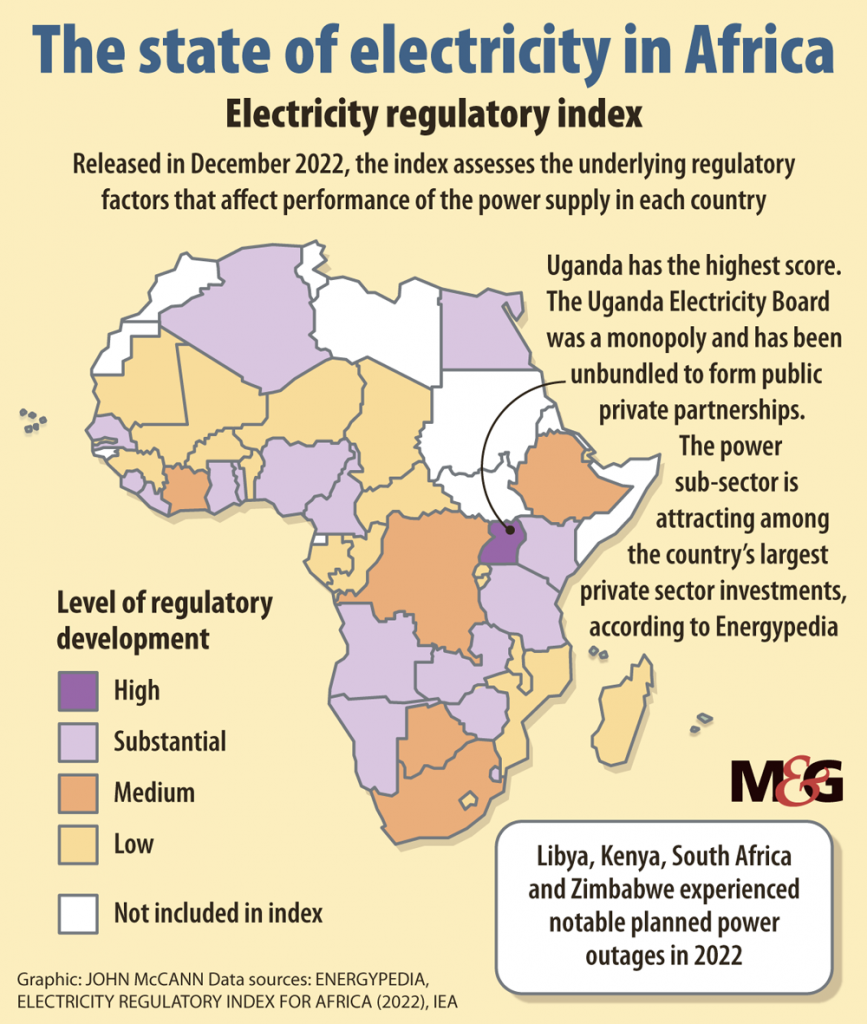
In Egypt, the center of the continental economy, authorities blamed the power outages on aging infrastructure and low investment in the sector.
Global financial uncertainty has made investors wary of deploying foreign direct investment into Egypt’s renewable energy sector, while the government’s grip on key national security sectors has also led to low investor interest, according to the Economist Intelligence Unit, a research and analysis division of the Economist Group.
In 2014, President Abdel Fattah el-Sisi described the energy crisis as “a war for our existence”.
Like many other African leaders, el-Sisi blamed the crisis on huge costs to finance the energy sector and poor investment.
This is a familiar story for countries such as Zimbabwe where a chronically damaged energy infrastructure spanning more than six decades has been blamed for 24-hour blackouts.
In Nigeria, the energy authority has reported that in March last year, the national power grid collapsed twice, leaving the country in darkness.
The researcher said that the Nigerian power grid, in 2019, collapsed 206 times since 2010, with the failure being blamed on a number of issues including “untrained personnel, shortages in local manufacturing, poor utility performance, theft of grid equipment, weather, gas supply , insufficient funding and the age of the network infrastructure”.
This is a script that has been announced across the continent, but UNECA notes that African countries have been slow to act on the long-standing crisis, saying that there is a “dependence on coal, which is contrary to global efforts to reduce greenhouse gas emissions; [while] dependence on hydropower is highly vulnerable to climate change”.
By 2020, the World Bank estimates that power outages cost Nigeria about $28 billion, which translates to 2% of the country’s GDP.
Richer African countries experiencing power outages have cited corruption as one of the reasons for the power crisis, while poor countries such as Malawi say low water levels at the country’s sole hydroelectric station are responsible for the energy deficit.
The NGO Renew’n’Able Malawi estimates that only about 12% of the population has access to the national grid, with rural electrification at about 2%.
Malawi is an example of how climate uncertainty can have a devastating effect on power generation in a country where up to 98% of energy production is hydro-based. There is potential to generate 350MW but generation may drop to 200MW due to reduced water levels.
President Lazarus Chakwera, like many of his African counterparts, has seen his political fortunes threatened as civil society and local residents put pressure on his administration to address the energy crisis.
Malawi has committed to promoting renewable energy but, like many African countries, investment is limited, according to the Energy Supply Corporation of Malawi.
As part of a broader effort to light up the continent, the African Development Bank (AfDB) says it aims to finance an energy program that aims to achieve universal access to electricity by 2025.
“One of the most effective ways to overcome these challenges is to rethink how to use water effectively and productively in the Zambezi River and other water sources to produce energy,” said Tapiwa Gomo, an independent researcher, recalling the time when electricity production at the Kariba Hydroelectric Station the food giant of several South African countries.
“This is also the time to invest in solar water,” he said.
The AfDB plan is to “provide 160GW of new capacity, 130 million new on-grid connections, 75 million new off-grid connections and provide 150 million households with access to cooking solutions.
“To achieve these goals, the estimated investment required will be between $60 billion and $90 billion per year.”
African countries went to COP27 hoping to get concessions to finance the continent’s energy sector; However, the loss and damage clause by rich countries again left the government back home to think how to solve the electricity shortage.
Although renewable energy has been touted as Africa’s best bet, the continent’s energy transition has faced many obstacles, including the capital-intensive nature of projects such as solar and natural gas plants, according to the International Energy Agency.
For Zimbabwean economist Eddie Cross, the answer to Africa’s energy crisis is straightforward: support from the global financial industry and the private sector.
“Furthermore, we must learn from past mistakes and ensure that corruption and poor decision-making do not derail these efforts.”