
GMX, a continuously trading decentralized exchange (DEX) allows up to 50X leverage, now produce The trading fee is higher than BNB Smart Chain (BSC) and Bitcoin.
GMX is the Third Most Active Platform
According to statistics, the 1-day GMX fee on January 19 was $589,000, while the BSC and Bitcoin chain fees, during the same period, were $524,232 and $328,935, respectively.
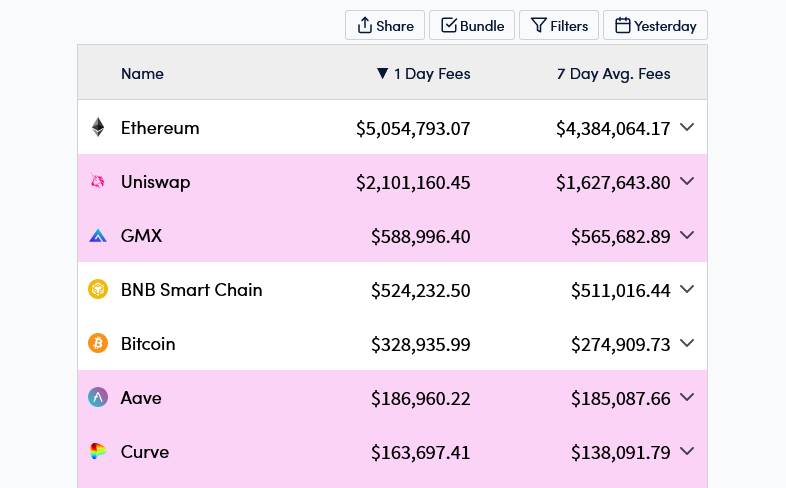
Ethereum and Uniswap are the only two major protocols that are more active than decentralized exchanges that trade continuously, according to the data above. During this time, the total cost of Gas received on Ethereum exceeded $5 million. On Uniswap, over $2.1 million, roughly 4x the daily cost of GMX and BSC.
GMX supports trading multiple coins, including BTC, ETH, and AVAX. At the time of writing, GMX has a total trading volume of $96,802,651,673 with open interest, that is, the number of open positions, long and short, $207,102,720. Meanwhile, more than 208,000 active traders use the platform to trade on Arbitrum and Avalanche. GMX was launched on Arbitrum and Avalanche, considering its scalability and lower cost than Ethereum.
Arbitrum is an Ethereum layer-2 platform that allows scalable and low trading fees. On the other hand, Avalanche is scalable and has the fastest settlement time in crypto. By launching on these two platforms, GMX says it allows users to save costs by entering and exiting positions with minimal spread and zero price impact.
Traders take profit from short positions in USDC and token quotes when long. The GMX price is based on Chainlink’s decentralized oracle to prevent price manipulation.
Trading Fees as a Measure of Activity
Trading fees generated by the dApp or on the blockchain are important activity indicators. Although users tend to choose protocols that offer near-zero fees, the decentralized nature of blockchain means that validators or entities that secure the core infrastructure must be paid.
In decentralized finance dApps like Uniswap and GMX, trading fees generated from swapping activities are distributed to liquidity providers (LPs). There are also distributed governance tokens. Anyone can be an LP.
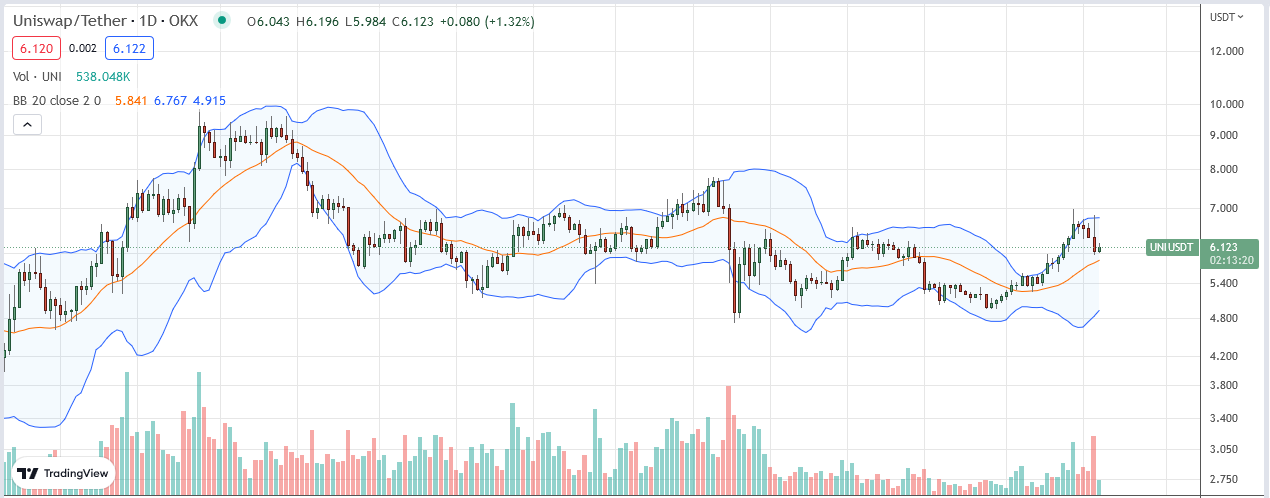
In September 2020, Uniswap distributed UNI to users who, in one way or another, used the protocol to exchange tokens before the airdrop distribution date. Today, UNI can be sold for 6.1 US Dollars.
Interestingly for GMX, the 1-day trading fee of $589,000 posted on January 19 exceeded the total average amount received during the past trading week of $565,682. The same trend can be observed in the top-5 most active platforms. Creating an extension in this regard can show new interest from users and traders who use the protocol in one way or another.
In GMX, it can mean more traders sending traders, targeting market clips and generating profits. Coincidentally, the increase in trading costs was recorded at a time when the cryptocurrency market appeared to be declining after losses. At least, this is the trend in 2022.
Options images from GMX, charts from TradingView.com